George Lomax
The Seven Dials MysteryGeorge Lomax is presented through two kinds of crisis: the baffling scene in which Jimmy Thesiger lies motionless, and George’s own attempt to propose marriage to Lady Eileen Brent. In both, he reaches for formal language and orderly explanations, but his words falter or outrun his judgment. His scenes make public decorum, social rank, and personal confidence comic counterweights to circumstances he cannot control.
Identity and Public Manner
George’s speech marks him as a man conscious of position and propriety. When he later explains his intention to Lord Caterham, he stresses that he does not undertake new responsibilities lightly and has given the matter deep consideration. He describes his position as carrying obligations and presents himself as a person accustomed to weighing questions carefully. The elaborate formality is not merely ornament: it is how he tries to establish that his decisions are responsible and his standing deserves respect.
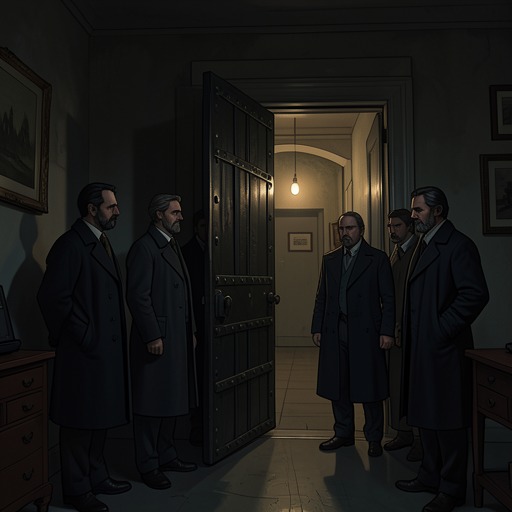
Yet his manner is notably less assured in practice than in self-description. At the room where Jimmy lies on the ground, George enters among a group of people almost falling through the doorway, and tries to ask what has happened. His question breaks apart into repeated starts: “The - the - the meaning of this?” He recognizes Superintendent Battle and asks what has happened, but his speech remains spluttered and halting. The confusion around him is immediate; his first response is not a clear assessment but an attempt to recover his bearings through a question.
Responses to Crisis
The scene with Jimmy exposes George’s dependence on other people to define events. He asks Battle what has happened, then, after the group has had a moment to recover, repeats the question as “Incredible!” He does not provide an explanation of the scene himself. Battle, by contrast, takes charge of the room and directs those present to return to bed. George’s response establishes him as a witness seeking an account, while the Superintendent controls the practical aftermath.
A later conversation shows George reacting anxiously when Battle lays out possible routes by which an intruder might have entered or left. Battle includes the possibility of an inside job, while carefully saying that the servants may be innocent and probably are. George nevertheless takes the suggestion personally: he says he has perfect reliance on his servants and would be greatly distressed to suspect one of them. His protest turns a general investigative possibility into a threat to his confidence in the household. Battle is not asking him to accuse anyone; George’s alarm comes from hearing suspicion named at all.
Courtship and Social Calculation
George’s proposal to Lady Eileen gives his formal habits a more personal target. In his account to Lord Caterham, he treats marriage as a decision requiring deliberation, listing equality of birth, similarity of tastes, suitability, and shared religion among the considerations. He also frames the match in terms of social position: he believes he can offer his wife a place in society, and says that Lady Eileen’s birth and breeding fit her for it. Her intelligence and political sense, he adds, could advance his career as well as serve their mutual interests. His description combines apparent admiration with an explicit calculation of how the marriage might benefit him.
He is also conscious of their age difference, but turns that potential objection into an argument in his favor. He insists that he feels vigorous and in his prime, and reasons that a husband should be older. A young, inexperienced rival, he suggests, would suit Lady Eileen less well than he would. He promises to cherish her youth and speaks of the privilege of watching her mind develop. The language casts him as a discerning protector, but its self-consciousness makes the proposal sound more like a case he has prepared than a response to what she might want.
The account of the proposal from Lady Eileen’s side sharpens that contrast. She says George spluttered and stuttered but persisted, and she suspects he had learned his speech from a book. Faced with his formal performance, she cannot recall the etiquette-book response she thinks she ought to give; instead, she tells him plainly that she will not marry him. She then jumps out of the window and bolts. Her account presents the rejection as decisive, while also showing how completely the encounter defeats her expectation of the proper social script.
Character and Narrative Function
George’s scenes repeatedly set polished social expectations against awkward reality. In a disturbed household, he wants an explanation and reassurance about the servants; in courtship, he presents a reasoned case that leaves Lady Eileen scrambling for a reply. His confidence in rank and convention does not prevent him from faltering in speech or misjudging the effect of his own words. The comedy depends on that mismatch: he takes propriety seriously, but propriety supplies no reliable method for resolving either an alarming mystery or an unwanted proposal.
His proposal also reveals the limits of his self-image. He speaks as though suitability can be established by weighing qualifications, social advantages, and age, yet Lady Eileen’s plain refusal cuts through the argument. George may regard himself as thoughtful and well placed to guide the decision, but the outcome belongs to her. Across these episodes, he remains recognizably attached to formal order even when events refuse to follow it.